Pocket Doors

A mini-guide for choosing the right sliding pocket door

How to understand the difference between the different models, to correctly calculate the dimensions of the door opening and the overall dimensions. How to choose and identify the type of frame on the basis of the door, the opening and walls. The box contains detailed information on each topic.

Aria Viva sliding pocket door systems

What is the difference between an exposed sliding door and a sliding pocket door?

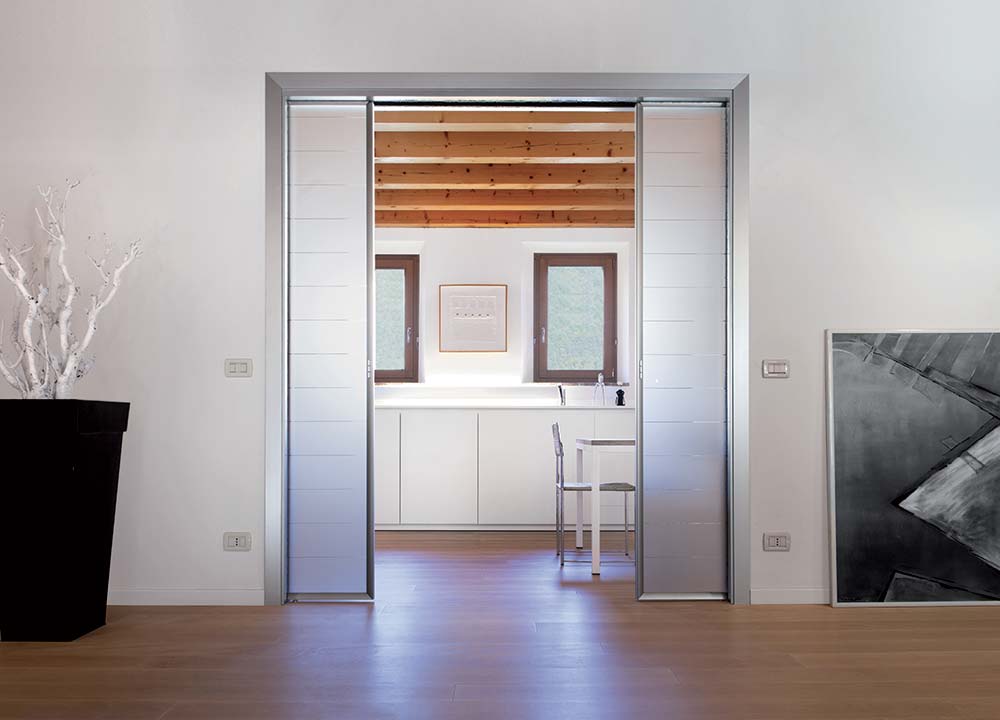
Unlike traditional hinged doors, sliding pocket doors allow to regain the space usually taken up by the radius of the door swinging and help create a wider and more welcoming environment, offering greater furnishing options. Removing the hinged doors, the home wins back more space that can be essential for rooms which are small in size, benefiting of a more refined interior decoration.

There are two types of sliding doors:

In the former case, the door opens by sliding alongside the wall, while in the latter case the door opens by sliding inside it, running into a system commonly known as the ‘frame’. The frame of a sliding pocket door is a metal pocket that allows the door to slide inside the wall concealing from sight. Both solutions solve a space problem but, compared to the exposed sliding door version, the sliding pocket door frees the space on the wall where the door slides, opening up to greater furnishing possibilities. Depending on the type of frame adopted, several different opening solutions can be obtained.

Aria Viva sliding pocket door systems - products range

A sliding pocket door system: what it is and how it works

The details of the metal structure are specially designed for both solid wall and stud wall

The frame for a sliding pocket door is a metal structure enabling the door to disappear inside a wall (either solid or stud wall). The frame is made up of a pocket that replace the wall section where the door is going to enter, a sliding system (track and runners) located in the upper part that allows the door panel to slide and a vertical metal door stop that accomodate the closing door.

To qualify as a premium-quality product, the frame necessarily needs to comply with specific reliability and durability requirements.

  • Sturdiness: the frame must be as sturdy as the wall and it has to be inspectable at any time to allow its maintenance without knocking the wall down.

  • Smooth and fluid sliding movement of the door: the runners and the track ensure the maximum smoothness to the sliding movement and can be easily replaced if they get damaged.

  • Guarantee of a steady and indeformable internal passage, resistant to lateral pressures, with no deflection of the pocket's metal sheet and, thus, no risk of hindering or damaging the door.

  • Guarantee of a crack-resistant plaster finish: being an integral part of the wall, the frame does not alter the appearance and consistency of the wall.

  • Easy installation and maintenance: a frame that is easy to assemble and to install even by non-expert personnel guarantees and safeguards the product over time. This is possible thanks to a maintenance free track fully extractable which enables to retrofit accessories after the installation with no need of masonry.


Always aiming at the best possible quality, in 30+ years of research Aria Viva has developed a product boasting the following features:
 

Calculating the dimensions of a sliding pocket door system

To properly calculate the sizes of a sliding pocket door system, it is first necessary to understand the difference between "door opening" (or passage size) and "maximum overall dimensions".

The door opening, or passage size, refers to the actual dimensions of the door hole in height and width, between the jambs (if present) and from the finished floor level to the top beam. A standard sliding pocket door has the same sizes of a corresponding hinged door. It is also possible to build customized solutions for very large or very small passage sizes.

The maximum overall dimensions refers instead to the total space required to install a sliding pocket door system. In width this size sums up the dimensions of the door opening and the pocket while in height it is given by the length from the finished floor level to the upper edge of the architrave.

While in a new construction you typically have the freedom to choose the door size you want, in renovation projects you may find some constraints and the overall dimensions is the obligatory starting point to choose the size of your door.

Types of frames for sliding pocket doors

Choosing the correct frame model is not difficult, but certain key factors must be taken into account. These include: the type of door, the type of opening and the type of wall.

  • Type of door: is the door going to be fitted with jambs or not (the so-called flush-to-the-wall doors).
    The jambs and architraves refer to all those elements that cover the wall edges around the doorway. In traditional doors, they normally protrudes from the door and the walls around the door panel. If instead there is no edgings, we refer to modern doors without jambs and architraves flush-to-the-wall. Each of these solutions requires a specific frame.


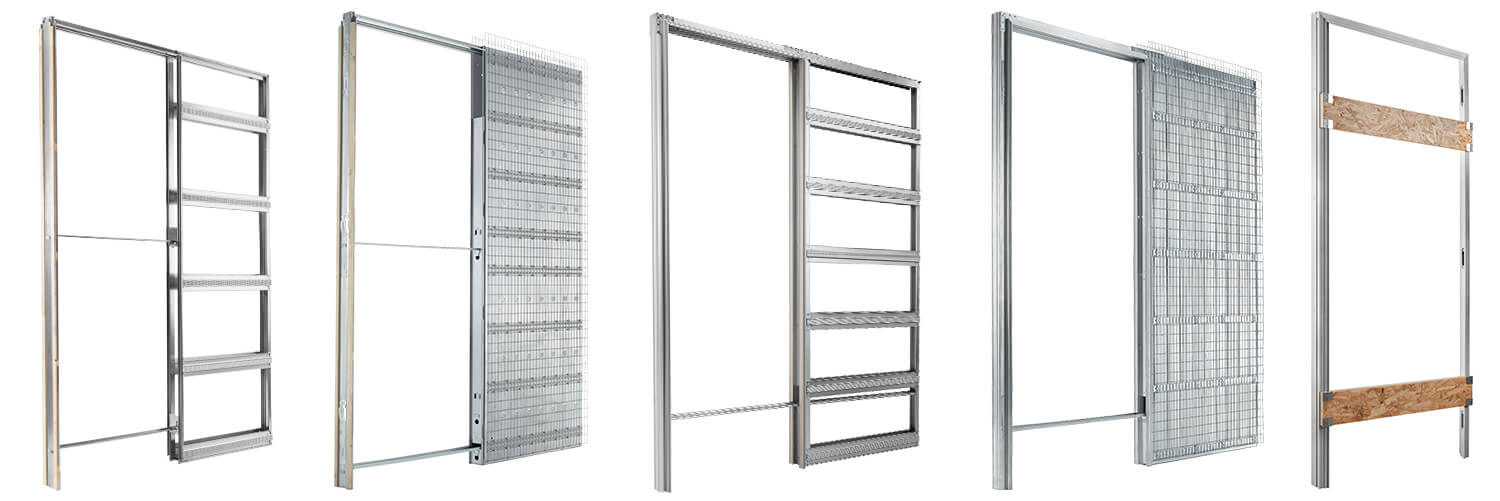
  • Regarding the construction material of the walls. Aria Viva has developed specific systems for both solid walls and stud walls. This section introduces the main differences between a frame for solid walls and and a frame for stud walls. A frame for solid wall is made up of a metal sheet layer and looks like a metal structure supporting the plaster mesh. On the other hand, the version for stud wall has an open structure, resembling a metal framework (U-shaped guides and C-shaped uprights), on which the plasterboard slabs are placed.


Frames for stud walls

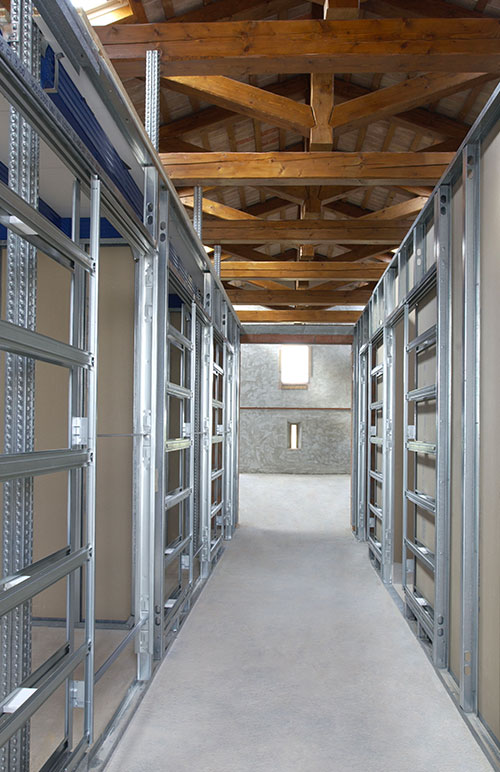
In the case of plasterboard walls, the frame has an open structure similar to a metal studwork, on which the actual plasterboard layers can be fixed.

The unassembled frame version (KIT) for stud wall has compact overall dimensions that facilitate both its transportation and handling and optimise its storage in warehouses (over 50 pieces fit into just one square meter). Moreover, since the structure thickness can be widen during the installation phase, it allows to decide on-site which internal passage to use (58÷83 mm) according to the finished wall thickness. Thanks to the innovative interlocking assembly system, no screws or screwdrivers are required, making the frame assembly easy and quick.

The open structure is 20% more resistant to lateral bending compared to equivalent products currently available on the market*.
The reinforced vertical bars, together with the horizontal bars, result in a far sturdier structure compared to frames made of a single 5÷10 mm metal sheet, normally found in closed structures.

* Based on internal laboratory tests conducted on various equivalent frames.

Aria Viva stud wall sliding pocket door systems
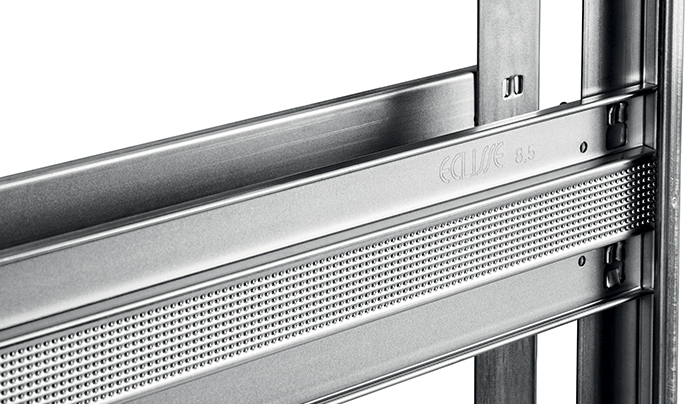
Perforated horizontal reinforced bars

Horizontal reinforced perforated bars

- Aria Viva patent -

Made of galvanised 7/10 thick metal sheet and dove-tail shaped to withstand lateral pressures, they are pre-drilled to ease the screwing of the plasterboards.
Vertical reinforced bars

Vertical reinforced bars

They are made from galvanized 12/10 thick steel with a double reinforcement fold for high resistance to bending.
Metal top beam

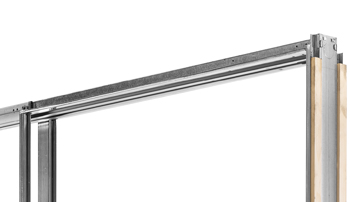
Metal top beam

Improves resistance to any pressure coming from above.
Frames for solid walls

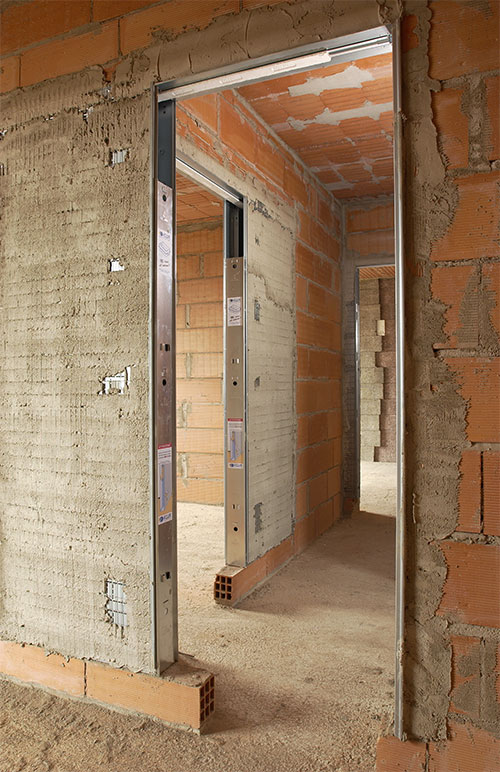
A frame with a closed structure, designed to be installed on masonry walls and integrate with the brick structure.

In this case a standard-size (800x2100 mm passage size) Aria Viva frame can weigh up to 40 kg, guarantee of incomparable solidity and strength.

Aria Viva solid wall sliding pocket door systems
Micro-ribbed filler plate

Micro-ribbed filler plate

Embossing is a punching process that creates elements in relief on a smooth metal sheet, improving the panel resistance to deformations due to lateral pressures.
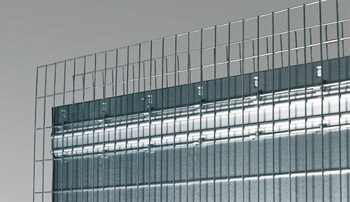
Protruding knurled plaster mesh

Protruding knurled plaster mesh

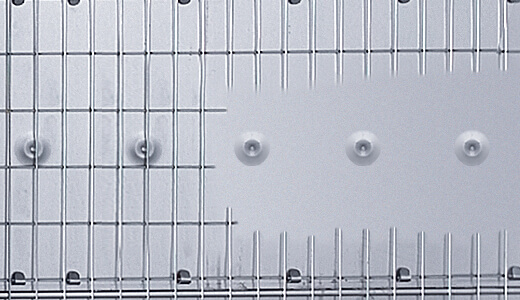
The tight mesh (50x25 mm) and the knurling of the single wires greatly improve the adhesion of the plaster to the metal sheet of the pocket, for an imperceptible joint between frame and wall.
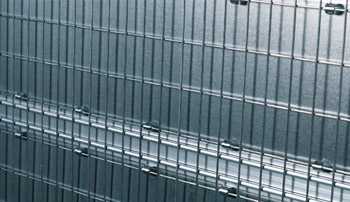
Horizontal reinforced bars

Horizontal reinforced bars

They bestow considerable resistance and rigidity on the frame so that it can effectively counter the tension generated by the drying of the plaster.